Your ski size guide from INTERSPORT Rent
You would like to rent or buy a pair of skis? Great! Maybe you already have a specific model in mind, but do you know which size is best for you? Choosing the correct ski length is crucial for your skiing enjoyment and safety on the slopes.
The correct ski length: more than just body size
You may know the rule of thumb that the ideal ski length is somewhere between your chin and forehead. But it's not just about body size!
Choosing the right ski is a very individual process and several factors play an important role:
- Height
- Weight
- Skiing ability
- Favourite terrain
- Skiing style
But don't worry: with our comprehensive ski size guide, you'll find the correct ski length for your needs in no time at all!
You are also welcome to drop by one of our more than 800 INTERSPORT Rent locations - our winter sports experts will advise you personally and equip you with the right model including accessories.
The right ski length for your ability and weight
As mentioned above, the general rule of thumb is that the ski tips should end somewhere between the chin and forehead. Below you will find size charts, which will give you an initial indication of the correct length.
However, this information is only a rough guide. Whether you opt for a longer or shorter model is, among other things, a question of personal preference. In addition, the skiing characteristics change depending on whether they are longer or shorter.
Shorter skis are ...
- more suitable for beginners as they are better to control.
- suitable for riders with low weight.
- easier to manoeuvre and more agile.
- better suited for fast, tight and short turns.
- more control in technically demanding terrain.
Longer skis are ...
- more suitable for advanced and experienced skiers.
- ideal for heavier skiers.
- more stable at higher speeds.
- better for fast and aggressive skiing.
- excellent for long, wide turns.
- more stable and offer better flotation in deep snow.
Choose the correct ski length according to your preferred area of use
The optimum ski length varies depending on your preferred terrain and skiing style. Here are our specific recommendations for different areas of use:
Classic skiing on the slopes
Who: Recreational skiers who mainly ski on groomed slopes and are less inclined to make fast turns.
Beginners and advanced skiers:
- Choose a ski that is about 10 cm shorter than your height.
- This makes them better to control, and you will find it easier to initiate turns.
- This length offers more safety when learning the right technique.
Experienced skiers and professionals:
- Choose a ski that is about 5 cm shorter than your height.
- This will give you a better carving feel and more control, allowing you to make more precise turns at higher speeds.
All-mountain skis – the versatile all-rounder
Who: Skiers who feel comfortable both on and off the slopes, looking for comfort and safety.
Beginners and advanced skiers:
- Your skis should be 5 to 10 cm shorter than your height.
- These dimensions are ideal for around 80 % slope skiing and 20 % off-piste adventures.
- They also offer a good balance between control and versatility.
Experienced skiers and professionals:
- Choose skis that are roughly your height or up to 5 cm shorter!
- Ideal for a ratio of around 50:50 on the slopes and off-piste.
- Enables both precise carving and sufficient float in deep snow.
Good to know: Are you still looking for the perfect all-mountain skis for your needs? Read our buyers guide for all-mountain skis. We have summarised all the important information for you.
The right length for your freeride skis
Who: Adventurers who enjoy off-piste skiing in powder, untracked terrain and love playful skiing.
Beginners and advanced freeriders:
- Choose skis that are about 5 cm shorter than your height.
- Facilitates control in challenging terrain.
- Enables steeper learning curve of deep snow skiing technique.
Experienced skiers and pros:
- Choose skis that are approximately your height or up to 10 cm longer.
- The width of the ski should be between 90 and 120 mm.
- Provides maximum flotation in deep snow and stability at high speeds.
Our recommendation: You can find even more tips on how to choose the right model for your needs in our buyers guide for freeride skis. In addition to important aspects of the ski, you will also find further tips on useful accessories for the backcountry.
Touring skis – light and versatile in the right ski length
Who: Winter sports enthusiasts who want to go on longer tours with lighter skis.
Advanced and professional skiers:
- Choose skis that are 5 to 10 cm shorter than your height.
- They offer maximum versatility and lightness.
- Enable efficient ascent and safe descent in varied terrain.
More information: Need a little more inspiration? Take a look at our Buyers Guide for touring skis!
Tip: If you want to know the correct ski length for your cross-country skis, we have dedicated a separate blog post to this topic. Here we explain the most important differences in terms of size for skating or classic style.

The right ski length for men: What should they consider?
When it comes to the right ski size for men, height is not the only factor to consider - men often weigh more and develop more power. Men can tend to choose slightly longer skis than the pure body size formula dictates, especially if ...
- the body weight is above average.
- an athletic riding style is favoured.
- you already have advanced riding skills.
| Body height (cm) | Beginner (cm) | Advanced (cm) | Experts (cm) |
|---|---|---|---|
| 160-165 | 150-155 | 155-160 | 160-165 |
| 165-170 | 155-160 | 160-165 | 165-170 |
| 170-175 | 160-165 | 165-170 | 170-175 |
| 175-180 | 165-170 | 170-175 | 175-180 |
| 180-185 | 170-175 | 175-180 | 180-185 |
| 185-190 | 175-180 | 180-185 | 185-190 |
| 190+ | 180-185 | 185-190 | 190-195 |
This is what matters when it comes to the correct ski length for women
The correct ski length for women should take physiological differences into account. Women often have a lower centre of gravity and on average less body mass than men of the same height. The following recommendations therefore apply:
- As a woman, choose a shorter ski than a man of the same height.
- Take your individual fitness and strength into account.
- Look out for special women's models that are designed to meet female requirements.
| Body height (cm) | Beginner (cm) | Advanced (cm) | Experts (cm) |
|---|---|---|---|
| 150-155 | 140-145 | 145-150 | 150-155 |
| 155-160 | 145-150 | 150-155 | 155-160 |
| 160-165 | 150-155 | 155-160 | 160-165 |
| 165-170 | 155-160 | 160-165 | 165-170 |
| 170-175 | 160-165 | 165-170 | 170-175 |
| 175-180 | 165-170 | 170-175 | 175-180 |
| 180+ | 170-175 | 175-180 | 180-185 |
The right ski length for children
Choosing the correct ski size for kids can be even more challenging than for adults. After all, the little ones grow so quickly! As a rule of thumb, the ski length should be approximately between the child's chest and nose.
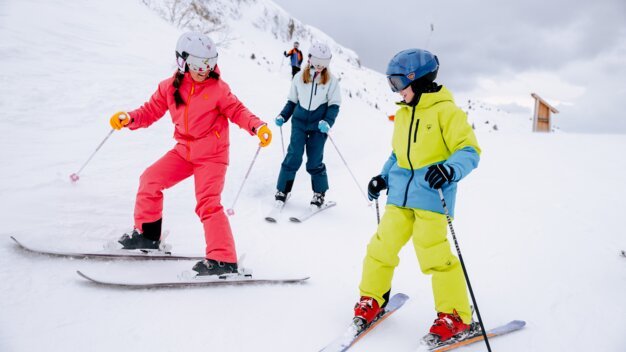
Is that too imprecise for you? For a more precise determination, it's best to proceed as follows:
- Determine your child's height and weight.
- Then look for the recommended ski length in a size chart for children as an initial guide.
Take additional factors into account:
- Choose a shorter ski if your child is very light, a beginner or prefers to ski slowly.
- Choose a longer ski if your child is rather heavy for its height, is an advanced skier or likes to ski fast.
Important to note: For children, the focus is on safety and simply learning the skiing technique. Skis that are too long make learning more difficult and can lead to frustration. It's better to choose something a little shorter and make skiing fun!
You can find more detailed information on this in our article on the right length for children's skis or directly in your local INTERSPORT-Rent shop!
Find your perfect ski length for maximum skiing fun
The right ski length is a decisive factor for your skiing pleasure. It doesn’t only improve your performance on the slopes, but also increases your safety and the fun factor. Always remember that the perfect ski length is individual and depends on your personal skiing style, ability and area of use.
A well-chosen ski in the right length will support you on your way to becoming an expert skier and give you unforgettable days in the snow!
Frequently asked questions about the correct ski length
How long should carving skis be?
Carving skis should be selected according to ability and intended use. For beginners, we recommend a length about 15 cm shorter than their height. Advanced skiers should choose skis that are 5-10 cm shorter. Professionals and sporty skiers can choose carving skis that are up to or slightly shorter. The stronger waist of carving skis enables precise turns and good edge grip even with a shorter length.
What is the disadvantage of skis that are too short?
Skis that are too short can have several disadvantages:
- Less stability at higher speeds
- Less stability on hard slopes
- Weaker edge grip in icy conditions
- Less flotation in deep snow
- Poorer performance on long, wide turns
- Progression can be limited for advanced skiers
Test different variants at INTERSPORT Rent to find the right ski length for you!
How do you calculate the right ski length?
If you want to determine the correct size you first need to determine your own height. In addition, factors such as weight, skiing style and level as well as ski type are important when it comes to choosing the the right length. For slope skiers, for example, applies the following:
- Beginners and advanced skiers: height minus 10 cm
- Experts: height minus 5 cm
How wide should a ski be?
Which width is the right one depends heavily on the type of ski and the preferred area of use:
- Skis for the slopes (approx. 65-75 mm): For groomed descents. Narrow skis enable quick edge changes and very smooth running at speed.
- All-mountain skis (approx. 75-90 mm): Versatile all-rounders for slope use and occasional off-piste excursions. Offer a good balance of stability, manoeuvrability and flotation.
- Freeride models (from approx. 95 mm): For deep snow adventures. The greater width provides more flotation and stability in powder and untracked terrain.
- Touring skis (approx. 80-95 mm): With a lower overall weight for the ascent. The width depends on the use: narrower for long tours, wider for more downhill performance.
Are wider skis easier to carve?
No, quite the opposite. A wider ski requires more effort and power to be turned on the edges. If you want to learn how to carve, you should aim for a ski with a narrow waist instead.
INTERSPORT Rent tip
The RENTertainer recommends
Are you lost in the jungle of ski stars? Don't despair! The RENTertainers in our more than 800 rental shops in Europe and Canada will help you to find the perfect ski length in no time at all - whether it's slope, touring or cross-country skis or a freeride set-up. Test different ski lengths before you buy to make sure you make the right choice.
In the shop you can also find the best accessories and other equipment for rent - to match your new skis. Take a look and discover our huge selection of alpine ski boots, poles in the right length and even ski goggles for spectacle wearers.
Related articles
You may also be interested in: